
Western astrology never mentions it. Vedic astrology builds your whole chart on it. Find yours below.
What is my nakshatra?
Your nakshatra is the lunar mansion the Moon occupied at the moment you were born. Vedic astrology calls it your Janma Nakshatra, your birth star, and treats it as the most personal point in your chart. The calculator above finds it from real astronomical positions, not from your birthday alone.
If you want the whole picture first, the complete guide to the 27 nakshatras covers their lords, deities, symbols and spans.
What is a nakshatra, exactly?
The sidereal zodiac is a circle of 360 degrees. Vedic astronomy divides that circle two ways at once. The familiar way gives 12 signs of 30 degrees each. The older way gives 27 nakshatras of 13 degrees 20 minutes each.
The word comes from Sanskrit and is usually read as a compound of naksha, a map, and tara, a star. In English they are called lunar mansions, because the Moon crosses roughly one of them per day as it travels the zodiac in about 27.3 days.
That is the practical difference. A Sun sign is shared by a twelfth of everyone alive. A nakshatra is one of 27 divisions, and once you add the pada, one of 108.
How do I find my nakshatra?
You need the position of the Moon at your birth, and that needs three things: date, place, and ideally time.
- Enter your date of birth.
- Enter your birth time if you know it. It decides your pada, and on most dates the nakshatra itself, because the Moon usually passes into the next nakshatra at some point during the day.
- Enter your place of birth, so the calculation uses the right time zone.
There is no shortcut from the date alone. The Moon moves about 13 degrees a day, so two people born on the same date in different years almost never share a nakshatra.
How does the calculator work?
It finds where the Moon was at the moment and place you were born, then reads which of the twenty-seven segments that position falls in.
- Your date, time and place become a single moment in universal time, using the time zone that applied at that place on that date, summer time included.
- The Moon's position at that moment comes from the JPL DE421 ephemeris, published by NASA's Jet Propulsion Laboratory, computed with the open source Skyfield library.
- That position is moved from the tropical to the sidereal zodiac by subtracting the ayanamsa. We use True Chitra Paksha, which for a birth in 1990 comes to about 23.84 degrees.
- The sidereal circle is cut into twenty-seven equal segments of 13 degrees 20 minutes, starting at 0 degrees Aries. The segment holding the Moon is your nakshatra, and the quarter of it, 3 degrees 20 minutes wide, is your pada.
The same engine runs every calculator on this site, and the method is set out in full on how we calculate.
Do I need my birth time?
For the nakshatra itself, usually yes. The Moon stays in one nakshatra for roughly a day, so on most dates it passes into the next one somewhere between midnight and midnight: on 96.1% of dates from 1970 to 2005, checked every week at a New York birthplace. When you give no time and your date is one of those, we show you both nakshatras rather than pick one.
For the pada you do need it. Each nakshatra is quartered, and each quarter lasts about six hours. Without a time we tell you your nakshatra and say plainly that the pada is unknown, rather than picking one and hoping.
What is a pada?
A pada is a quarter of a nakshatra, 3 degrees 20 minutes wide. Twenty-seven nakshatras of four padas each give 108 divisions, a number that recurs throughout Indian tradition.
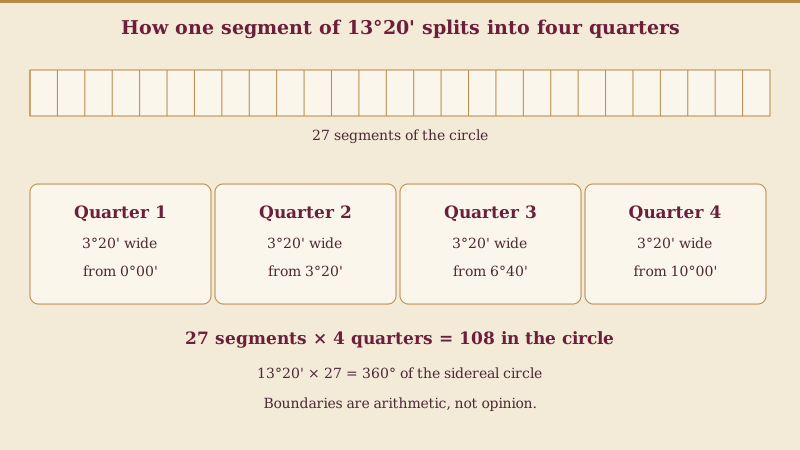
In practice the pada narrows the reading. Two people can share Rohini and read quite differently because one is in the first pada and the other in the fourth.
What are the 27 nakshatras?
In order around the zodiac, beginning at 0 degrees sidereal Aries:
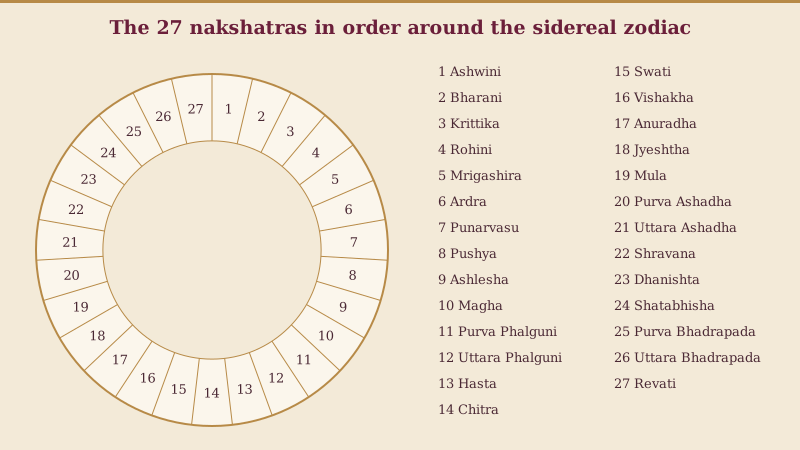
Each carries a ruling planet, a presiding deity and a symbol. Ardra belongs to Rudra, the storm. Pushya belongs to Brihaspati and is considered the most auspicious of the 27. Krittika belongs to Agni, fire, and its symbol is a blade.
Is my nakshatra the same as my zodiac sign?
No, and they usually do not even agree about which sign you are.
Your Western zodiac sign comes from the Sun, measured against the tropical zodiac, which is anchored to the seasons. Your nakshatra comes from the Moon, measured against the sidereal zodiac, which is anchored to the stars. The two frames have drifted about 24 degrees apart, so a Western Gemini is usually a Vedic Taurus.
Neither system is more accurate than the other. They measure different bodies against different reference points and answer different questions.
Where do these meanings come from?
The calculation is astronomy: ephemeris positions of the Moon for your exact moment and place, with the sidereal correction applied. That part is not interpretation.
The meanings are tradition, and we name where they come from rather than presenting them as our own insight. The symbol, presiding deity and ruling planet of each nakshatra are standardised across the classical sources. The short character reading draws on the shakti verses of the Taittiriya Brahmana, the nakshatra passages of the Brihat Parashara Hora Shastra and the Brihat Samhita of Varahamihira, with modern compilations used to confirm readings where the classical texts are terse.
Where sources disagree on a symbol, we say so on that nakshatra's page rather than picking the tidier version.
An honest note on what this is
Astrology here is offered for reflection and self-understanding. It is not prediction, diagnosis or advice, and we do not promise outcomes. The astronomy is calculated and real; what it means is a tradition of interpretation, and we present it as that.