
Your star sign comes from the Sun. Your Vedic birth sign comes from the Moon, measured against the stars. For most people they are different signs entirely.
What is my moon sign?
Your Moon sign is the zodiac sign the Moon occupied at the moment you were born. Vedic astrology calls it your Janma Rashi, your birth sign, and reads it before anything else in the chart. The calculator above finds it from real ephemeris positions of the Moon, with the sidereal correction applied.
How do I read my result?
The result card has five parts, and each one answers a different question.
- The sign in large type is your Vedic Moon sign, the Janma Rashi, with its Sanskrit name. This is the sign Vedic astrology treats as your birth sign.
- The two signs side by side put the sign you have called yourself on the left and your Vedic birth sign on the right. They usually differ for two reasons at once: the left one is a Sun sign measured in the Western zodiac, the right one is a Moon sign measured in the sidereal zodiac. When both land on the same sign we say so, because it is uncommon.
- The degree and the nakshatra show how far into the sign the Moon stood, from 0 to 30, and which of the 27 lunar mansions that places it in. A Moon under 1 degree or over 29 sits close to a sign boundary, which is exactly where a birth time matters most.
- Element, modality and ruler are the fixed facts every school agrees on. The ruler is the planet that governs the sign, and it is the part Vedic astrology uses to compare two Moon signs for compatibility.
- The dignity line appears only in three signs: the Moon is exalted in Taurus, at home in Cancer and debilitated in Scorpio. In the other nine it is absent, which is ordinary.
Below the card sits the traditional reading of the Moon in your sign and its classic marker. That part is interpretation rather than astronomy, and it is labelled that way. All twelve readings are on the moon sign guide, and comparing your Moon with someone else's is on moon sign compatibility.
Why is my Vedic Moon sign different from my star sign?
Two separate differences stack on top of each other, which is why the gap surprises people.
Different body. Your familiar star sign is your Sun sign. This is your Moon sign. The Sun takes a month to cross a sign; the Moon takes about two and a half days. They are almost never in the same place.
Different zodiac. Western astrology uses the tropical zodiac, anchored to the seasons and the spring equinox. Vedic astrology uses the sidereal zodiac, anchored to the actual stars. The two were aligned roughly two thousand years ago, and the slow drift of the Earth's axis has opened a gap of about 24 degrees since. That drift is called precession, and it shifts most placements back by roughly one sign.
Do I need my birth time?
For the sign itself, often not, but not always. The Moon stays in one sign for about two and a half days, yet on 43.9% of dates it moves into the next sign at some point during the day. We measured this for every week from 1970 to 2005 at a New York birthplace. On those dates the birth time decides it.
You do need it if you were born on a day the Moon changed signs, and you need it for the nakshatra pada, which changes roughly every six hours. Give the time if you have it, and we will use it. If you do not, we tell you what we could determine and what we could not.
What does the Moon sign actually describe?
In this tradition the Moon governs the mind: how you feel, react, remember, and what makes you feel safe. It is treated as the more private layer of a person.
The Sun, by contrast, is read for vitality, outward identity and the role you take in the world. Both traditions use both bodies. They disagree about which one to put first.
Which is more accurate, the Sun sign or the Moon sign?
Neither. This is the question we get most, and the honest answer is that it is the wrong question.
They are not two competing answers to the same thing. They measure different bodies against different reference frames and describe different layers. What we can tell you is exactly where your chart lands in each, and let you judge which reads truer.
How is the Moon sign calculated?
Three inputs, one calculation:
- Date and time fix the moment.
- Place gives the coordinates and the correct time zone for that date, including historical offsets.
- The Moon's ecliptic longitude at that moment is taken from ephemeris data, and the ayanamsa, the current tropical-to-sidereal offset, is subtracted.
Whatever 30-degree segment remains is your Janma Rashi. The finer 13-degree-20-minute segment is your nakshatra.
The 12 Moon signs and their rulers
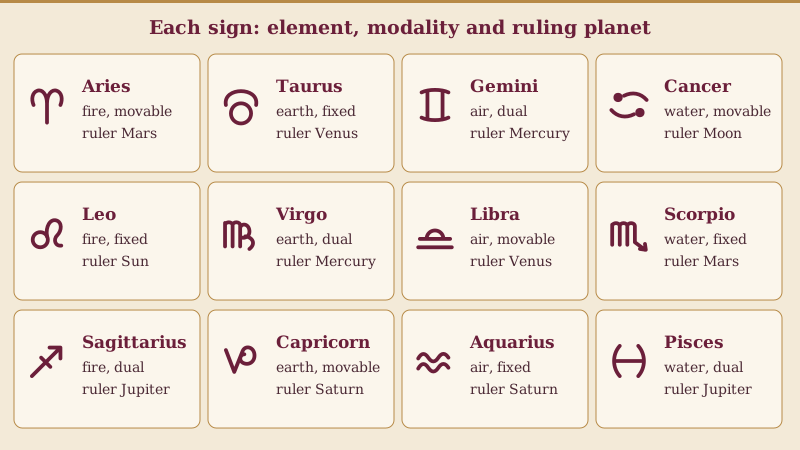
| Sign | Sanskrit | Element | Ruler |
|---|---|---|---|
 Aries Aries | Mesha | fire | Mars |
 Taurus Taurus | Vrishabha | earth | Venus |
 Gemini Gemini | Mithuna | air | Mercury |
 Cancer Cancer | Karka | water | Moon |
 Leo Leo | Simha | fire | Sun |
 Virgo Virgo | Kanya | earth | Mercury |
 Libra Libra | Tula | air | Venus |
 Scorpio Scorpio | Vrischika | water | Mars |
 Sagittarius Sagittarius | Dhanu | fire | Jupiter |
 Capricorn Capricorn | Makara | earth | Saturn |
 Aquarius Aquarius | Kumbha | air | Saturn |
 Pisces Pisces | Meena | water | Jupiter |
Two placements are singled out in the classical texts: the Moon is exalted in Taurus, with the exact point at 3 degrees, and debilitated in Scorpio, at the same degree. Cancer is its own sign.
Elements, rulers and the Moon's dignities follow the Brihat Parashara Hora Shastra and are standardised across schools.
What if the Moon changed signs on the day I was born?
Then the date alone cannot settle it, and we tell you so. We measured how often this happens: on 43.9% of dates from 1970 to 2005, checked every week at a New York birthplace, the Moon was in one sign at the start of the day and another by the end of it. When you give no birth time and your date is one of those, the calculator shows both signs instead of quietly picking one. Add your time of birth and the answer becomes a single sign.
Is this calculator free, and what happens to my details?
It is free and it does not ask for a name or an email. Your date and time of birth are used to compute the result and are not saved. To turn a place into coordinates, a place we have not looked up before is sent once to OpenStreetMap's public geocoding service, and the place name with its coordinates is kept so the next lookup is instant. Nothing is attached to you or to an account. More detail is in the privacy policy.
An honest note on what this is
Astrology here is offered for reflection and self-understanding. It is not prediction, diagnosis or advice, and no outcome is promised. The astronomy is calculated and real; what it means is a tradition of interpretation, presented as exactly that.